 AideAI
Use AI to Understand Class Material Faster, Not Just Generate Answers
Most students try AI because they want faster answers.
That is not always the same thing as faster understanding.
You can get a clean paragraph about a topic and still feel lost when the quiz asks you to apply it, explain it in your own words, or connect it to something from last week's lecture. The answer looked smart. The concept did not stick.
That gap is exactly what AideAI's learning workflow is for: help you get the material, not just receive text about it.
Fluent Is Not The Same As Clear
Generic AI chat is good at sounding confident.
It can define a term, summarize a concept, or rewrite an explanation in simpler language. That helps when you need a quick overview.
It helps less when:
- the explanation does not match how your professor taught it
- you are confused about one step, not the whole topic
- you need to connect today's reading to last week's lab
- you have lecture notes, a PDF, and a practice problem open at the same time
- you need to know whether you actually understand or just recognize the wording
Understanding is slower and more specific than answer generation. It usually needs context, follow-up, and a chance to ask the question behind the question.
The "I Saw This Before" Problem
A common student moment looks like this:
You read the slide. You attended the lecture. You even wrote notes. Then the homework or quiz arrives and the concept still will not move from recognition to recall.
That usually means the material never became yours.
You saw the explanation. You did not work through the confusion.
A useful study assistant should help with that middle step: explain the idea at your level, ask what still feels fuzzy, and stay grounded in the course material you are actually responsible for.
That is different from asking a blank chat box to "explain photosynthesis" and hoping the answer matches your class.
Learn Mode Is For Understanding, Not Shortcuts
AideAI includes Learn as one of its core student modes, alongside Plan, Write, and Wellness.
Learn is tuned for explanation, simplification, and check questions — not for doing graded work on your behalf. The goal is to help you practice understanding:
- explain this in simpler language
- ask me where my reasoning breaks down
- quiz me on the parts I keep missing
- connect this concept to the rest of the unit
That makes Learn useful when the problem is confusion, not output.
If your problem is structure, thesis clarity, or revision, Write mode is the better lane. If your problem is prioritization, Plan mode fits better. Learn is for the moment when you need the concept to click.
For a workspace where those modes stay separate, read Meet Agent Desk: A Multi-Agent Workspace for Students.
Study From The Material You Already Have
Generic chat starts from zero.
AideAI can start from the academic context you already built:
- lecture transcripts and summaries
- PDFs and assigned readings
- notes and files attached to chat
- coursework connected through Canvas or Google Classroom
- the broader semester picture in Study overview
That matters because understanding is easier when the assistant can refer to your material, not a generic textbook version of the topic.
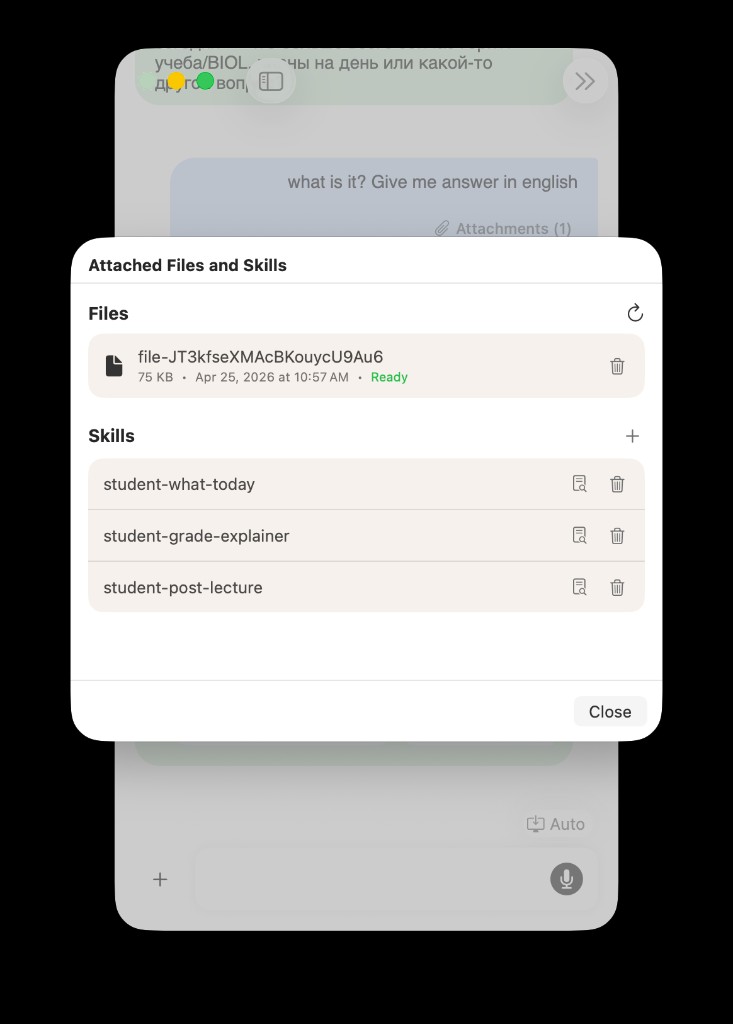
Grounded study works best when the assistant can see the lecture notes, PDF, or other material you are actually working from.
For the file layer, read Use PDFs, Notes, Docs, and Audio as Real AI Context. For lecture capture, read How to Turn Lectures Into Notes, Summaries, and Action Items. For semester visibility, read How to Finally See Everything Going On in Your Semester.
A Chemistry Quiz, Before And After
Before: you paste "explain equilibrium" into a generic chat. You get a polished paragraph. It still feels abstract. You move on because the answer looked complete.
After: you open Learn mode with your lecture summary and assigned reading attached. You ask:
Explain equilibrium the way my professor framed it, then ask me one check question.
The assistant explains in simpler terms, points to the part of your notes that matters, and asks where your reasoning gets weak. You realize you were mixing up two related ideas. Now the quiz topic feels smaller and more concrete.
That is the difference between generating an answer and building understanding.
Questions That Actually Help You Learn
The best learning prompts are specific and iterative.
Try prompts like:
- Explain this concept as if I missed the last ten minutes of lecture.
- Here is what I think is happening — tell me where my reasoning breaks.
- Ask me three short check questions and follow up when I hesitate.
- Compare this reading explanation to what was said in class.
- What is the smallest version of this idea I should be able to explain out loud?
Avoid prompts that skip the learning work entirely, especially for graded assignments. The useful role of AI here is to clarify, quiz, and simplify — not to replace the thinking you still need to do yourself.
When you are ready to turn understanding into writing structure, read How Students Can Use AI to Write Better Essays and Assignments.
When Generic AI Feels Good Enough
Sometimes a generic explanation is enough.
If you need a quick definition, a broad overview, or a one-off clarification, a normal chat question may be all you need.
Learn mode and grounded context matter more when:
- the course material is dense or cumulative
- you are preparing for an exam, not just finishing one question
- your confusion is about a specific step or connection
- the professor's framing matters for the test
- you keep rereading the same notes without progress
That is when understanding beats speed.
Try Learn Mode In AideAI
If AI has felt helpful for a minute and useless an hour later, the problem may not be AI itself. It may be that you were getting answers without building understanding.
Open Learn mode, bring in the material you already have, and work through the concept with follow-up questions until it feels smaller and clearer.
Start on AideAI Free for the core learning workflow. Compare plans on Pricing if you want stronger models or advanced features later.