 AideAI
Turn a Project Sync into a Pull Request Without Losing Decisions

This is a walkthrough of one Tuesday afternoon—not a feature catalog.
Assume a three-person CS team shipping a class project called CampusPilot. They use AideAI for recordings and OpenAI Codex for implementation. Codex is already connected (setup guide).
4:10 p.m. — the sync that usually evaporates
Maya, Jordan, and Priya jump on a 20-minute call.
They agree, roughly:
- roll out a pilot release behind a feature flag
- keep the old dashboard until the whole team has the flag
- add a smoke test before merge
- maybe redesign settings later—Priya likes the idea, nobody commits
Someone says “we should also clean up the README.” Nobody owns it. It dies in the recording.
If this call only lives in memory, Jordan will implement the settings redesign “since we’re touching deploy anyway,” and Friday’s review will restart the meeting.
4:35 p.m. — keep the evidence in AideAI
Maya recorded the call in AideAI (or imported the audio). AideAI already knows how to turn meetings into notes, summaries, and action items. For coding, they need one more move: share the meeting with Codex on purpose.
In Apps → Codex, Meetings is on. Other sources stay off—Jordan does not need mail or clipboard for a feature flag.
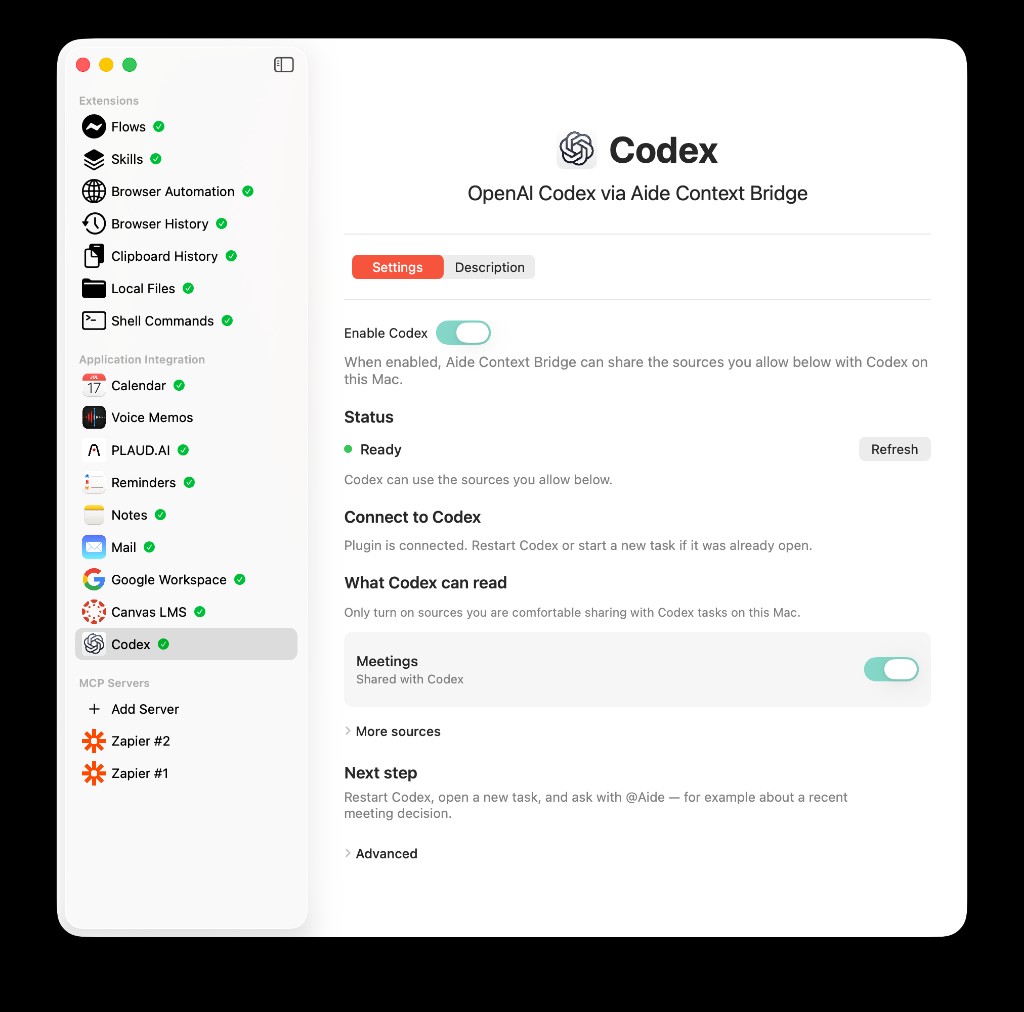
Before coding: Status Ready, plugin connected, and Meetings shared—nothing else required for this task.
5:00 p.m. — ask Codex for decisions, not a transcript dump
Jordan opens a new Codex task and starts with @Aide:
What did we decide about the CampusPilot pilot release? Separate confirmed decisions from proposals and open questions.
What they want back is structured context, not a twelve-page paste:
- Decision: feature-flagged pilot release
- Decision: keep the old dashboard until full rollout
- Commitment: smoke test before merge
- Proposal / not decided: settings redesign
- Weak / unowned: README cleanup
If AideAI finds little, Jordan checks that the meeting exists and Meetings is still on—before writing code.
5:10 p.m. — confirm scope like a human teammate
Jordan does not let Codex invent product ownership.
They reply with an explicit confirmation:
Implement only the flag-gated pilot path and smoke test. Do not redesign settings. Do not touch README unless required for the flag docs.
That sentence is the difference between “AI coding” and “AI coding that matches the meeting.”
Broader framing: From Meeting Notes to Working Code.
5:15–6:30 p.m. — implement in the project
With scope locked, Codex works like a normal coding assistant:
- add the feature flag for the pilot path
- keep the old dashboard when the flag is off
- add a minimal smoke test
- run the test
- summarize changed files
Before opening the pull request — a five-line checklist
Jordan writes a short pull request description that mirrors the meeting:
- Meeting decision: flag-gated pilot; old dashboard until full rollout
- Out of scope: settings redesign; unowned README cleanup
- Files touched: (list)
- Tests: smoke test added/passed
- How to verify: flag off → old path; flag on → pilot path
Reviewers can disagree with the decision—but they should not have to reverse-engineer whether the change matched the sync.
What usually goes wrong (and the fix)
| Failure mode | Fix |
|---|---|
| Codex invents a redesign | Confirm out-of-scope items before edits |
| No meeting context | Meetings on; AideAI running; meeting exists |
| Old Codex window | New task after install or repair |
| Too many sources on | Start with Meetings only |
| Pull request is vibes-only | Copy decisions + tests into the description |
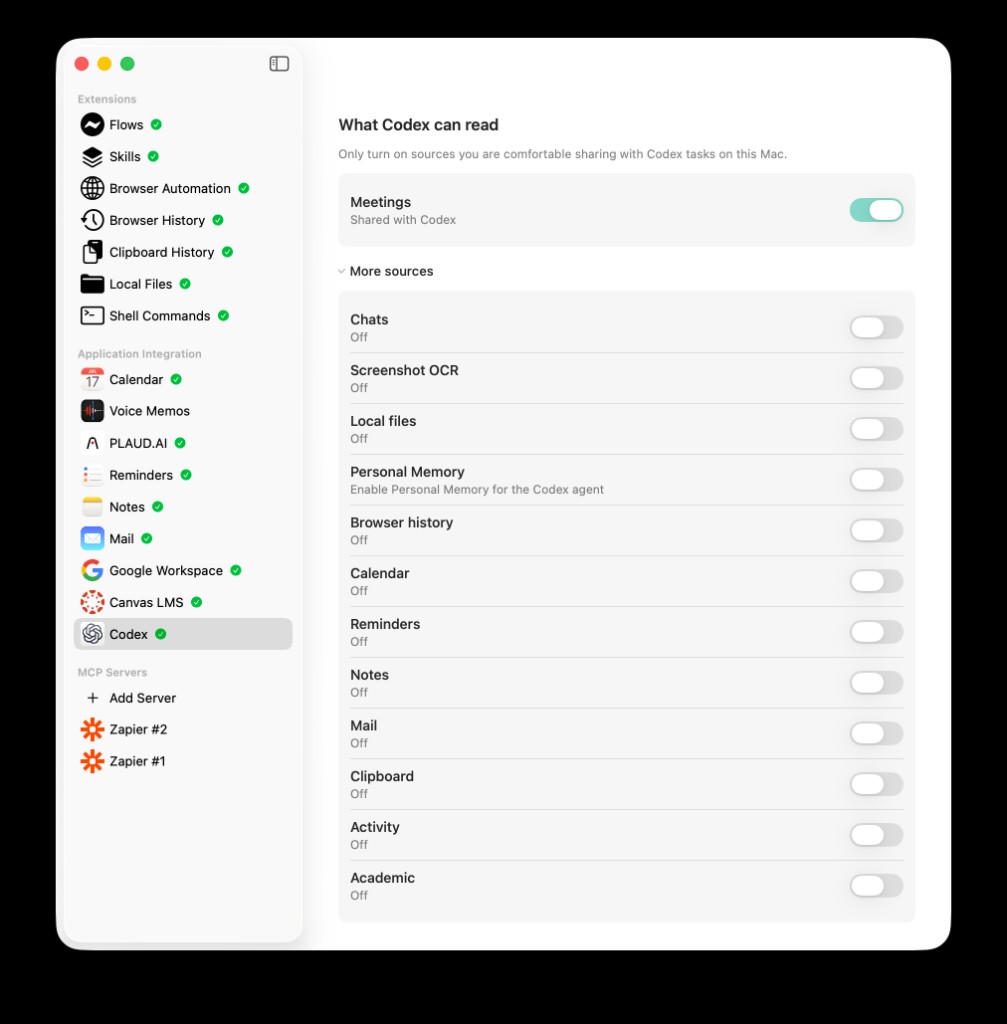
For a focused coding task, Meetings on and everything under More sources off is the safe default.
Why this beats “paste the transcript into ChatGPT”
Pasting dumps noise. AideAI + Codex is built for ask, confirm, then implement: pull meeting context, separate decisions from ideas, then code. You still own the product call. The tools reduce lost context, not responsibility.
Privacy controls: What Codex Can Read from AideAI — and What Stays Local.
Try it on your next team call
- Record the sync in AideAI.
- Confirm Codex Status is Ready.
- Ask
@Aidefor decisions vs open questions. - Confirm scope in one short message.
- Implement, test, and write the pull request as if the reviewer was not in the meeting.
That is the whole promise for this workflow: the meeting still matters after everyone hangs up.