 AideAI
How to Stay Productive in College Without Burning Out
College productivity advice usually sounds like it was written for a machine.
Wake up earlier. Block every hour. Never miss a reading. Batch your email. Review every lecture the same day. Exercise, sleep, cook, work, socialize, apply for internships, and somehow stay calm.
That advice is not always wrong. It is just incomplete.
Students do not only manage tasks. They manage attention, energy, stress, sleep, food, health, money, jobs, roommates, commutes, family obligations, and weeks where one class quietly becomes three times heavier than expected.
So the better question is not:
How do I squeeze more work into the same week?
It is:
How do I make steady progress without building a system that only works when I am already fine?
Burnout Is Not A Time Management Problem
Burnout is often described like a scheduling failure: too many tasks, not enough hours.
But students can burn out even when the calendar technically fits.
The issue is usually the load underneath the schedule:
- every task feels urgent
- no assignment has a clear first step
- rest feels guilty instead of useful
- a bad day turns into a bad week
- catching up requires so much effort that you avoid looking at the backlog
- the plan assumes the same energy every day
That last point is the trap.
Most productivity systems pretend your energy is flat. College is not flat. A Monday after a full weekend shift is different from a Thursday after sleeping well. A 30-minute reading can be easy in the morning and impossible after a long lab.
If your plan ignores that, the plan is fragile.
The Myth Of The Perfect Student Week
The perfect student week looks good on paper.
You attend every class, start every assignment early, summarize every lecture, keep your inbox clean, work ahead, eat well, exercise, and go to sleep at a reasonable time.
Then real life happens.
One professor moves a deadline. A group project creates extra messages. A required reading is denser than expected. Your laptop update breaks something. You lose an evening to a family call. You stay up too late once, and the next morning's plan becomes fiction.
The problem with the perfect week is not that it is ambitious.
The problem is that it has no recovery path.
A sustainable study system should expect friction. It should help you recover from a messy day without turning the rest of the week into punishment.
Plan By Energy, Not Just Priority
Priority matters. But priority alone is not enough.
If your highest-priority task requires deep focus and you have 20 minutes of tired attention left, forcing it may not be the best move. You might be better off doing a smaller task that protects tomorrow:
- collect the sources for the paper
- rename messy lecture notes
- skim the assignment prompt and write the first question
- send the message that unblocks a group project
- make a short list of what tomorrow's first step should be
This is not laziness. It is sequencing.
AideAI's planning workflow is useful here because the question can be more honest than a normal to-do list:
I have four things due this week, but I am exhausted tonight. What is the smallest useful move that makes tomorrow easier?
That is a better student productivity question than "How do I finish everything?"
For the daily planning layer, read What Should I Do Today? A Better Way to Plan Your College Work.
What Wellness Mode Is Actually For
AideAI Wellness mode is not a doctor, therapist, emergency service, or diagnostic tool.
It is designed for general support around habits, movement, sleep, nutrition, and sustainable routines. That distinction is important.
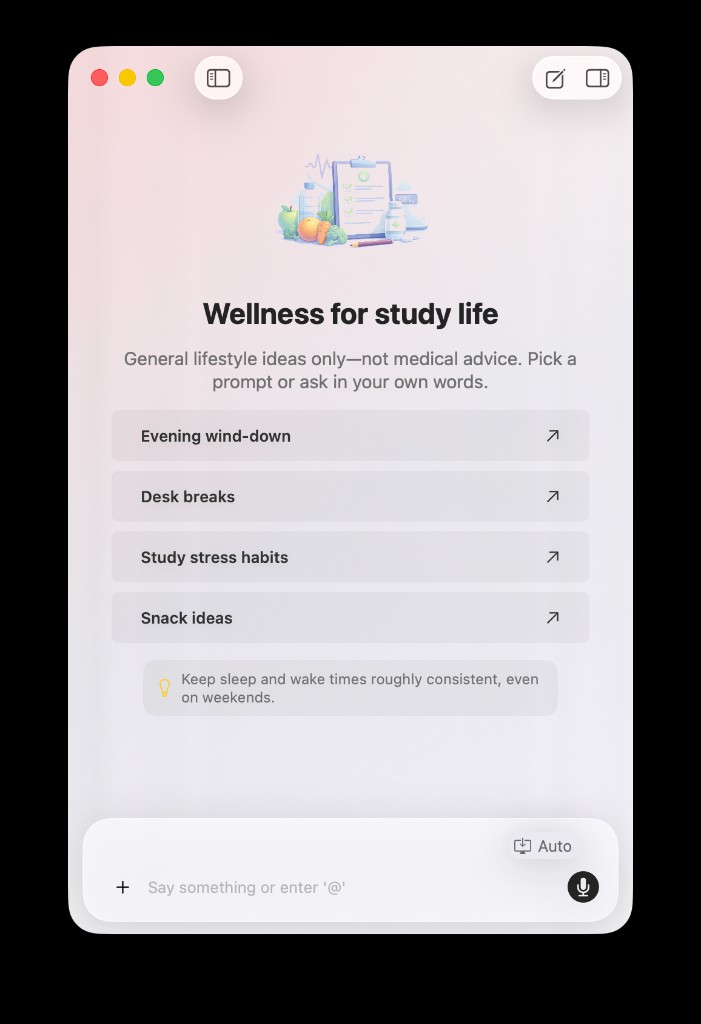
Wellness mode gives students general lifestyle prompts for study-life routines while clearly framing the feature as not medical advice.
Good wellness support for students should not say:
You are burned out, here is the treatment.
It should help with smaller, safer questions:
- What is a realistic wind-down routine before sleep?
- How can I add movement on a day when I have back-to-back classes?
- What would a low-effort meal plan look like this week?
- How do I restart after two unproductive days without shame?
- How can I make tonight's study plan less punishing?
That kind of help is practical, not medical.
If something is urgent, serious, or health-related in a clinical way, the right next step is qualified human support. But for everyday student rhythm, a supportive assistant can help you notice when the plan has become unrealistic before it collapses.
A Sustainable Study Week Has Buffers
Students often remove buffers first.
The plan gets tight, so the breaks disappear. Sleep moves later. Meals become random. Exercise becomes "after finals." Catch-up time becomes invisible. Then one unexpected task breaks the whole schedule.
Buffers are not wasted time. They are what make the system survive contact with reality.
Useful buffers can be small:
- 15 minutes after class to turn scattered notes into a next step
- one open block each week for catch-up
- a shorter task reserved for low-energy evenings
- a morning check-in before opening five different apps
- an evening shutdown note so tomorrow starts with context
AideAI can help make those buffers concrete. A planning thread can decide what matters today. A Wellness thread can help keep the routine humane. Agent Desk can keep those different kinds of help separate, so a study plan does not get buried inside a long writing conversation.
For the multi-agent workspace, read Meet Agent Desk: A Multi-Agent Workspace for Students.
The Catch-Up Day Should Not Be A Punishment
Every student has catch-up days.
The dangerous version starts like this:
I wasted yesterday, so today I need to do everything.
That plan usually creates another bad day.
A better catch-up day starts with triage:
- What is genuinely due soon?
- What can be reduced, postponed, or made smaller?
- What is the one task that unlocks the most relief?
- What should not be attempted today because it needs a clearer mind?
- What would count as enough progress?
This is where AideAI can be helpful because the assistant can turn emotional overload into a sequence. You are not asking it to magically remove the workload. You are asking it to make the next two hours less chaotic.
The key is to define "enough" before you start.
Without that, catch-up days become endless. With it, you can finish a block of work and actually stop.
Use AI To Lower Friction, Not Raise Expectations
There is a bad version of AI productivity.
It says: because the assistant can help, you should now do more.
More summaries. More plans. More drafts. More flashcards. More reminders. More automation. More optimization.
That misses the point.
For students, the best use of AI is often to lower the cost of doing the work you already needed to do:
- start faster
- decide sooner
- recover context
- turn a messy backlog into a small plan
- make a first draft less intimidating
- review a lecture without replaying the whole thing
- notice when the plan is too heavy for the day you actually have
Productivity without burnout is not about doing infinite work with better tools.
It is about spending less energy on avoidable friction, so the energy you do have goes toward learning, writing, showing up, and recovering.
That is why AideAI is built as a native Mac app rather than just another browser tab. The assistant is closer to the work, which makes it easier to ask for help before the day has already gone sideways.
For the native app layer, read Why a Native Mac App Feels Better Than Another Browser Tab.
A Simple Anti-Burnout Check-In
Here is a small workflow to try at the beginning of a heavy week.
Open AideAI and ask:
Help me plan this week without overloading myself. Ask me what is due, what my fixed commitments are, and where my energy is likely to be low.
Then answer honestly.
The useful output is not a perfect calendar. It is a plan that admits reality:
- the hardest work gets placed where focus is most likely
- smaller admin tasks go into lower-energy pockets
- catch-up time is visible
- rest is not treated as a failure
- the first step for each big task is clear
If the plan still looks impossible, that is useful information. It means the workload needs reducing, renegotiating, or triaging, not just "more discipline."
Try Wellness Mode In AideAI
If your current system only works when you are fully rested, ahead of schedule, and emotionally calm, it is not a very good student system.
AideAI can help you plan in a more sustainable way: use Plan mode to decide what matters, Wellness mode for general habits and rhythm, Agent Desk to keep different kinds of help organized, and native Mac entry points when you need support close to the work.
Start with one practical question:
What is the smallest plan for today that still moves me forward?
That is often where sustainable productivity begins.